
Act Two: After the Diagnosis
Patients and families often feel lost after a dementia diagnosis. We explore the options to maintain function in the disease’s early stages, from the oldest habits to the newest drugs and therapies.

When Hillary Raskin finally got her diagnosis, it was more confirmation than surprise — she had been living with the early symptoms of her dementia for years. The hardest part, she says, was that she didn’t know what to do next. A photojournalist diagnosed with a form of dementia that erodes language, Raskin left with a name for her condition and little other counsel. “I didn’t know what to do, and I didn’t know where to turn,” she told an audience of clinicians, caregivers and fellow patients at a New York dementia education conference this Spring. “I needed a road map. I needed a guide.”
Raskin was one of three people living with dementia who shared their experiences of life after the diagnosis in a session they called “Act Two,” to describe how they coped with the shock and looked for a way to keep living. While much of the cultural conversation around dementia is focused on the agonizing late stages of the disease, none of the panelists spoke of waiting for decline; all were searching for how to sustain and enrich their lives for as long as possible. Jim Stanley, a social worker diagnosed with mild cognitive impairment five years ago, described reaching “the other side, to a place of hope and resilience, and even hard-won abundance.”
The core post-diagnosis experience they described is well-known among people who work in the field. Stephanie Shivers, who runs programs at dementia charity CaringKind, calls it “diagnose and adios:” the news gets delivered, the doctor says come back in six months, and the family walks out with little ongoing support. Michael Pollack, a third panelist who is living with Alzheimer’s Disease, said: “If you get cancer, you’re immediately connected to a cancer survivor. If you’re an alcoholic, you go to a group, you get a sponsor. Where is my sponsor?”
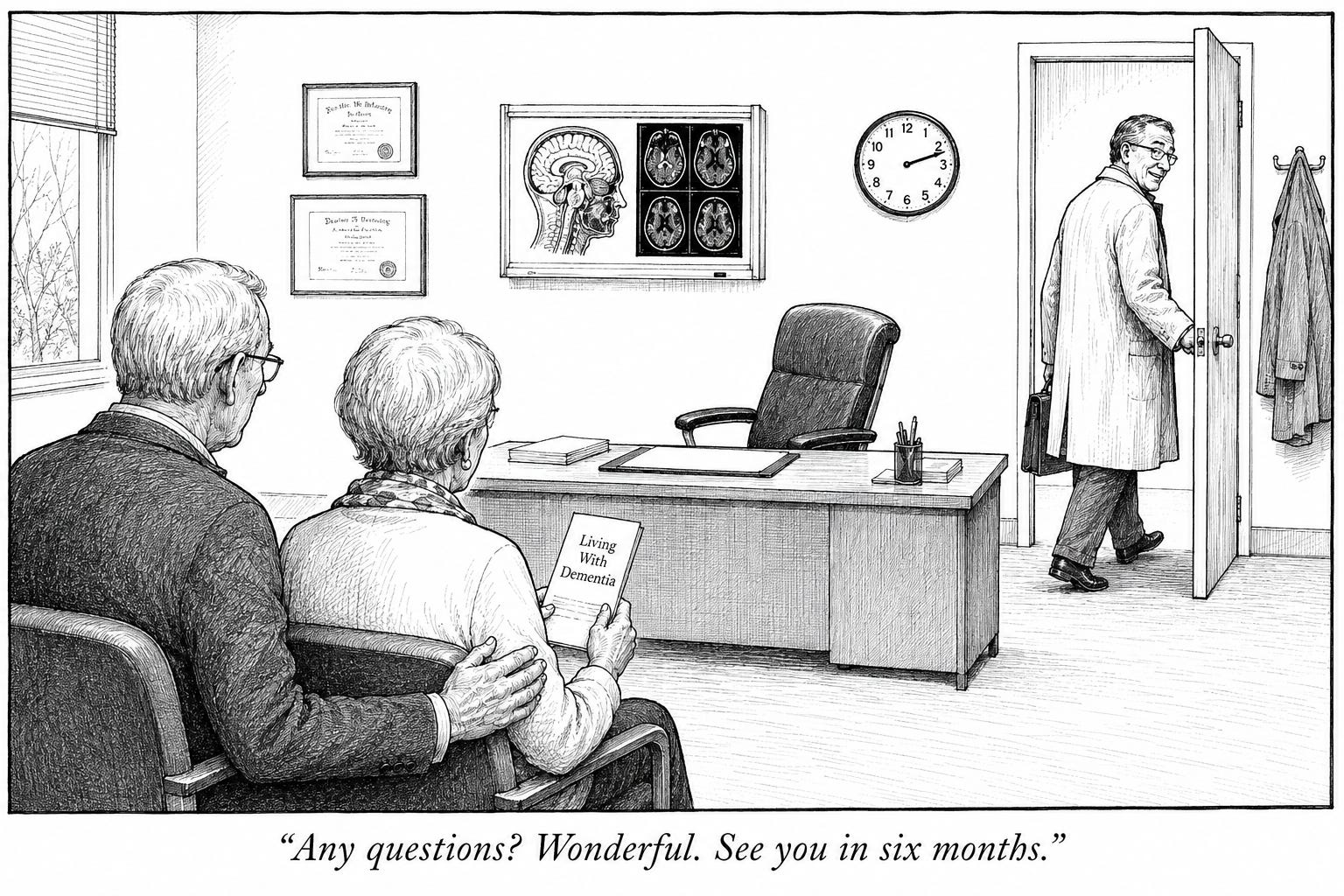
Patients and families often take years to recognise the early symptoms of dementia and obtain a diagnosis — a journey we covered in detail in last week’s Aging Almanac — so it’s little wonder that families expect more support once the verdict has been delivered. But with advances in therapeutics and research, there is now more available for newly-diagnosed families. The options, both old and new, fall into four parts: drugs that manage symptoms, drugs that slow the disease itself, the daily habits that support a working brain, and a type of therapy that is gaining increasing attention for its success with dementia patients, known as cognitive stimulation therapy (CST).
The Limits of Medicine
Until recently, the only medications available for people living with dementia were for symptom management. So-called “cholinesterase inhibitors” (donepezil, rivastigmine and galantamine, sold as Aricept, Exelon and Razadyne) have been in use for about thirty years and they can steady memory and attention for a time — usually around 6 to 12 months. Memantine, sold as Namenda, works a different way and is often added alongside them. These medications eventually lose efficacy because while they support brain function, they do not slow the underlying disease in the brain. Nor do they help all patients: the same pill can help one type of dementia and do nothing for another.
The last three years have brought the first drugs that modify the disease itself, rather than its symptoms: lecanemab and donanemab, sold as Leqembi and Kisunla, are the first treatments shown to slow Alzheimer’s Disease. Given by infusion every two to four weeks, they work by clearing amyloid, the protein that builds up in the Alzheimer’s brain. The benefit is real but modest: the drugs roughly double the chance that patients can arrest their decline but do not reverse it. In the trials, about a third of patients on placebo held steady over eighteen months, compared to roughly 70 per cent on the drug. (1, 2) The new therapies do nothing for Lewy body, fronto-temporal or vascular dementia, which together make up a significant share of cases and still have no drug that changes their course. Lecanemab and donanemab were FDA-approved for the treatment of early-stage Alzheimer’s Disease in 2023-24, and in 2025, the FDA approved a version that could be administered at home with a weekly injection.
The arrival of these new therapeutics was hailed as the first real progress against Alzheimer’s in two decades, but they are not without controversy — specialists have been split over whether a modest slowing of the disease is worth the accompanying risk. The drugs can cause brain swelling or small bleeds, a dangerous side effect called ARIA that occurs in a sizable minority of patients and at higher rates for carriers of a particular gene variant. To manage this risk patients are tested for the gene, and then have repeat MRIs while on the drug. A 2025 Alzheimer’s Association survey found many Americans willing to accept some risk for a chance to slow the disease, but whether the balance is worth it is a judgement each patient makes with their neurologist. (3) A next generation of “shuttle” antibodies is now in trials, including trontinemab, which aim to get more of the drug into the brain with less risk of ARIA. If successful, FDA approval is still a year or two away. (4)
The drugs are also costly: lecanemab costs about $26,500 a year and donanemab about $32,000, in addition to the expense of the required scans. Medicare pays for both drugs, but a patient on original Medicare still owes the 20 per cent co-insurance, around $5,000 a year, unless they hold supplemental coverage, and Medicare Advantage plans demand prior approval before the first infusion. (5)
Even then the drugs are hard to actually get. Eisai and Biogen, which make lecanemab, set an early goal of 10,000 American patients by March 2024 and missed it badly: only about 2,000 were on the drug that January. Uptake has climbed since, and first-quarter 2026 sales were up 74 per cent on the year, but the base is still small. By the end of November 2025, about 13,000 Americans had received at least one dose since the drug launched in 2023. Most who start stay on it, with about two-thirds still in treatment after two years. (6) The reason is infrastructure. A candidate needs a specialist who is willing to prescribe, a confirmed amyloid result from a PET scan or spinal tap, genetic testing, an infusion centre within reach, and repeated MRIs to watch for swelling and bleeds. That machinery is concentrated in urban teaching hospitals and is much harder to access across rural America, where a shortage of neurologists already means long waits.
For many newly-diagnosed families, then, the drugs will be a small part of the answer, and the newer therapeutics may not feature at all. Another strategy is within everyone’s reach, and it starts at home.
The Daily Habits that Help
For Jim Stanley, it started with walking or running to clear his head; meditation and exercise, he said, were what brought him out of the initial shock. Michael Pollack adjusted his diet and became a marathon runner — he ran the Boston and New York City Marathons in the same year — and he makes a point of going out every day and trying to get lost. Hillary Raskin found solace and guidance in a Caring Kind-sponsored support group, through which she has met other people living with the early stages of dementia, engaged in conversation and activities, and shared her experience.
Their instincts are sound. Over the past decade, our understanding of what supports brain health has grown, and it includes a Mediterranean or MIND-style diet built on vegetables, fish and olive oil, regular exercise, a protected seven hours of sleep, and social engagement. These habits don’t treat the disease, but they can help people at risk or in the early stages of dementia to maintain better daily function, steadier mood, and a longer stretch of independence.
The 2024 Lancet Commission on dementia estimated that up to 45 per cent of cases could be delayed or prevented by addressing fourteen risk factors across a lifetime: among them high blood pressure, smoking, diabetes, obesity, physical inactivity, excess alcohol, social isolation, depression, untreated vision or hearing loss, and high cholesterol. (7) Neurologists say the most overlooked of these risk factors is hearing. Untreated hearing loss was the largest single risk factor named by the Lancet Commission, and in a 2023 trial, hearing aids slowed cognitive decline by nearly half among older adults at higher risk. (8) The leading explanations are twofold: the effort of decoding muffled sound drains mental resources that would otherwise go to memory and thinking, and the strain of not being able to follow a conversation pushes people out of company and into the isolation that wears on the brain in its own right. For a newly-diagnosed patient a hearing test can make a world of difference.
The Alzheimer’s Association’s U.S. POINTER trial, reported in 2025, helped to establish that it’s never too late to start on prevention. Researchers put more than 2,000 older adults at risk of decline through two years of deliberate lifestyle change: regular exercise, the MIND diet, mental and social challenge, and routine health checks with a clinician. Both a closely structured program and a lighter, self-guided version improved thinking and memory, with the structured group gaining more, and the benefit held across age, sex, ethnicity and genetic risk. It was the first large American trial to show that ordinary habits, done deliberately, can protect the aging brain. (9)
As the disease progresses, developing a routine is also supportive. A predictable daily rhythm reduces the confusion and anxiety that unsettle people living with dementia, ideally making the most of mornings, when they tend to be at their sharpest. Andrea Pidgeon’s 82-year-old mother, TJ, has kept one since her diagnosis last year: up early to feed the dog, breakfast, her pills, an hour’s walk, painting, a nap when she needs one. “Routine is very important,” Pidgeon says. “It’s definitely like a prescription.”
Physical Therapy for the Brain
The anchor of TJ’s morning comes at ten, tea in hand: a half hour session talking with an AI called Sunny. Some mornings it’s a word game, some a guessing game, some just a conversation about her dog or the boating trips she took with her father as a girl. The clinic behind Sunny, NewDays, has developed an innovative version of cognitive stimulation therapy, an established intervention for maintaining cognitive function in people living with dementia.
CST has been around for more than 25 years. It was developed in 2000 by Amy Spector, a clinical psychologist at University College London, on a plain premise: that the thinking parts of the brain, like muscles, hold up better with use. In its original form it’s a small group program for five to eight people with early to moderate dementia, meeting twice a week with trained facilitators to work through themed sessions of discussion and activity. The aim isn’t to test memory or drill facts, but to get people talking, associating and forming new thoughts in company.
The evidence is unusually good for a non-drug treatment. Studies have found that CST improves cognition, mood and quality of life, with a cognitive benefit some analyses put on a par with the cholinesterase drugs. (10) In Britain it’s written into clinical guidelines for dementia care, and a diagnosis there can come with a prescription for it. It has since been adopted in more than 30 countries.
In the US, access to CST remains patchy. You can find CST in some memory clinics, occupational and speech-therapy departments, academic geriatric programs, adult day centres and senior-living communities, as well as charities like CaringKind. But CST is yet to become a standard of care. Researchers describe an implementation gap: it is an inexpensive, evidence-backed therapy that is still not a routine part of post-diagnostic care because it is held back by short staff time, thin training and no dependable way to bill for it. (11)
Insurance has been one barrier. Medicare will pay for cognitive rehabilitation, but not nearly enough of it. “Unfortunately Medicare doesn’t cover the number of interactions you would need with your therapist to really see the benefit,” says Daniel Kelly, who founded NewDays after watching dementia move through several members of his father’s family.
At NewDays, Kelly’s solution is to split the work between trained clinicians and AI. NewDays patients see a neuropsychologist by video every two weeks to discuss progress and set personal goals, and practice for 30-60 minutes a day with the AI at home. This ensures that the therapy is delivered at the optimal dose. Kelly likens it to “physiotherapy for your brain:” you see the cognitive therapist, then you do the exercises in between. The daily practice with Sunny, he says, stretches what Medicare covers across a whole year, rather than a handful of visits. It needs only a device and an internet connection, so patients and caregivers don’t need to drive anywhere or keep to a group’s timetable. Meanwhile the clinician relationship provides ongoing in-person support tailored to the patient’s needs, addressing both day-to-day functional problems and the mental health concerns that many patients experience.
Whether it works as well as the original in-person experience isn’t yet settled but early indications hold promise. Last week, NewDays presented early results at the Alzheimer’s Association International Conference: based on a case series of two dozen patients over six months, patients preserved the equivalent of a year and half of cognitive function, when without intervention, they would have been expected to lose it. (12) A randomised trial with Kaiser Permanente, following more than two hundred patients, is under way. (13) For TJ the change was quick. Her neurologist noticed she was more talkative and active; she took up daily painting and started FaceTiming her beloved grandchildren again. “It’s definitely extended her life,” her daughter says.
Hillary Raskin, who participated in a CST group with CaringKind, said that the therapy was one of the things that answered her call. Her request was simple. “Help me adjust to my today,” she said. “I’ve really started to care about my today.”
In next week’s Aging Almanac, we’ll turn to how caregivers can seek out support to help them adjust to their loved one’s evolving circumstances.
